

pdfLaTeX2 páginascompilado en 1.85 s53.0 KB
Plantilla LaTeX Artículo de investigación académica
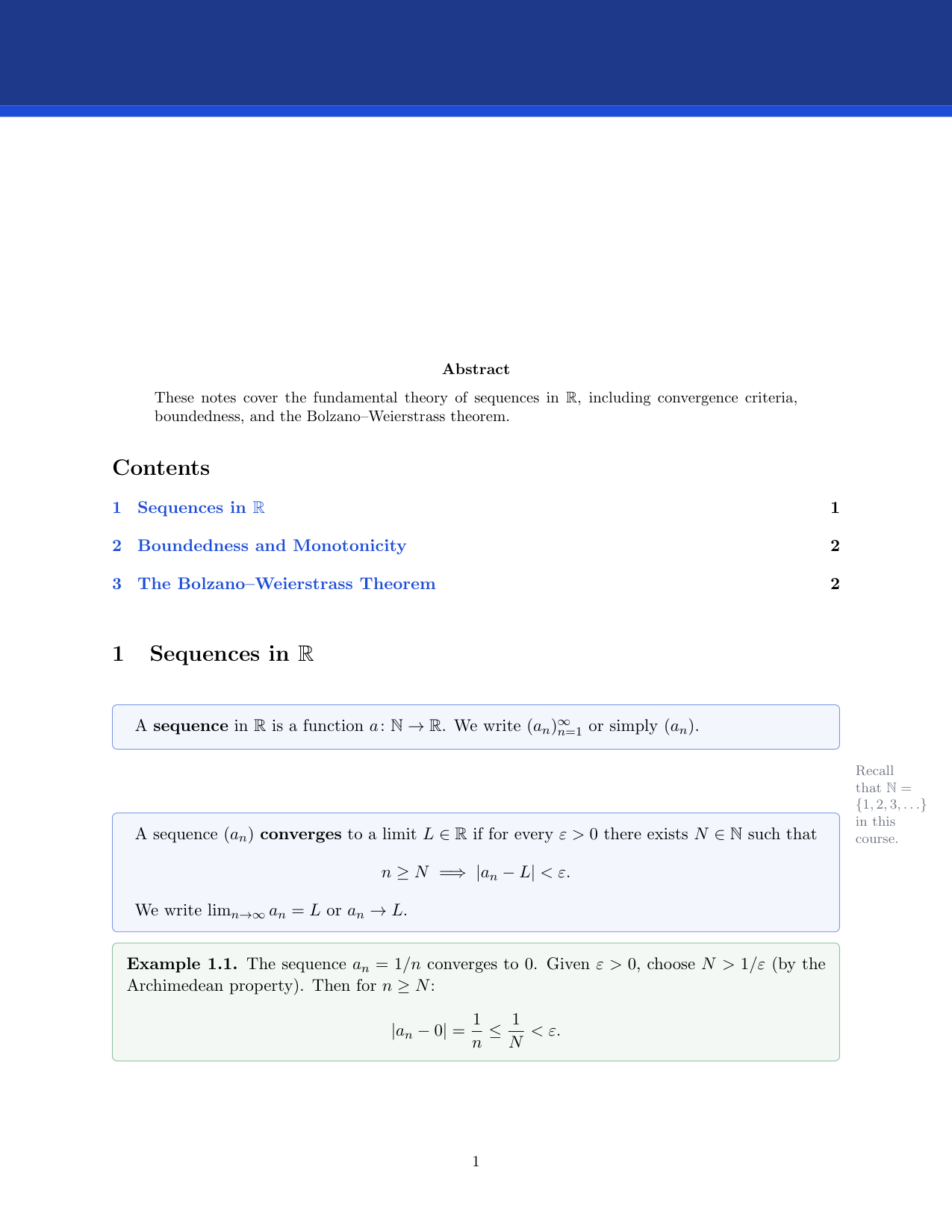
Artículo académico cuidado con entornos de teoremas tcolorbox, filetes de sección de color, bloque de título personalizado y resumen con estilo — listo para enviar a una revista.
\source{academic-paper}
\documentclass[11pt,a4paper]{article}
\usepackage[margin=1in,top=0.85in]{geometry}
\usepackage{amsmath,amssymb,amsthm}
\usepackage{xcolor}
\usepackage{tcolorbox}
\usepackage{titlesec}
\usepackage{fancyhdr}
\usepackage{microtype}
\usepackage{enumitem}
\usepackage{hyperref}
\usepackage{tikz}

\tcbuselibrary{theorems,skins,breakable}

% --- Color palette ---
\definecolor{accent}{HTML}{1D4ED8}
\definecolor{accentlight}{HTML}{DBEAFE}
\definecolor{thmcolor}{HTML}{1E40AF}
\definecolor{lemcolor}{HTML}{065F46}
\definecolor{darktext}{HTML}{111827}
\definecolor{subtext}{HTML}{6B7280}
\definecolor{rulecol}{HTML}{93C5FD}

\hypersetup{colorlinks=true,linkcolor=accent,citecolor=accent,urlcolor=accent}

% --- Section styling ---
\titleformat{\section}
  {\large\bfseries\color{darktext}}
  {\textcolor{accent}{\thesection.}}{0.5em}{}
  [\vspace{1pt}\textcolor{rulecol}{\rule{\linewidth}{0.5pt}}]
\titleformat{\subsection}
  {\normalsize\bfseries\color{darktext}}
  {\textcolor{accent}{\thesubsection}}{0.5em}{}
\titlespacing{\section}{0pt}{14pt}{5pt}
\titlespacing{\subsection}{0pt}{10pt}{3pt}

% --- Header / footer ---
\pagestyle{fancy}
\fancyhf{}
\fancyhead[L]{\small\textcolor{subtext}{\textit{<<title>>}}}
\fancyhead[R]{\small\textcolor{subtext}{<<author>>}}
\fancyfoot[C]{\small\textcolor{subtext}{\thepage}}
\renewcommand{\headrulewidth}{0.3pt}
\renewcommand{\headrule}{\hbox to\headwidth{\color{rulecol}\leaders\hrule height \headrulewidth\hfill}}

% --- Theorem boxes ---
\tcbset{
  thmstyle/.style={
    enhanced,breakable,
    colback=#1!6,colframe=#1!70!black,
    fonttitle=\bfseries\small,
    left=6pt,right=6pt,top=4pt,bottom=4pt,
    arc=3pt,boxrule=0.5pt,
  }
}
\newtcbtheorem[number within=section]{theorem}{Theorem}
  {thmstyle=thmcolor,attach boxed title to top left={yshift=-2mm,xshift=4mm},
   boxed title style={colback=thmcolor,arc=2pt,boxrule=0pt}}{thm}
\newtcbtheorem[use counter from=theorem]{lemma}{Lemma}
  {thmstyle=lemcolor,attach boxed title to top left={yshift=-2mm,xshift=4mm},
   boxed title style={colback=lemcolor,arc=2pt,boxrule=0pt}}{lem}
\newtcbtheorem[use counter from=theorem]{corollary}{Corollary}
  {thmstyle=thmcolor!70!lemcolor,attach boxed title to top left={yshift=-2mm,xshift=4mm},
   boxed title style={colback=thmcolor!70!lemcolor,arc=2pt,boxrule=0pt}}{cor}

\newenvironment{proof-env}{\noindent\textit{Proof.}\enspace}{\hfill$\square$\medskip}

% --- Title block ---
\makeatletter
\renewcommand{\maketitle}{%
  \begin{center}
    \begin{tikzpicture}
      \node[inner sep=0pt,text width=\textwidth-2pt,align=center] (t) {%
        {\LARGE\bfseries\color{darktext} \@title}\par\vspace{6pt}
        {\normalsize\color{subtext} \@author}\par\vspace{2pt}
        {\small\color{subtext} \@date}
      };
      \draw[rulecol,line width=1pt] (t.south west) -- (t.south east);
    \end{tikzpicture}
  \end{center}
  \vspace{6pt}
}
\makeatother

\title{<<title>>}
\author{<<author>>\\\small\textit{<<department>>}}
\date{\today}

\begin{document}
\maketitle

% --- Abstract ---
\begin{tcolorbox}[
  enhanced,colback=accentlight,colframe=accent,
  title=\textsf{Abstract},fonttitle=\bfseries\small,
  arc=3pt,boxrule=0.6pt,left=8pt,right=8pt,top=5pt,bottom=5pt,
  attach boxed title to top left={yshift=-2mm,xshift=5mm},
  boxed title style={colback=accent,arc=2pt,boxrule=0pt,
    fontupper=\color{white}\bfseries\small}
]
\small <<abstract_text>>
\end{tcolorbox}

\vspace{6pt}

\section{Introduction}

Let $f:\mathbb{R}^n\to\mathbb{R}$ be an $L$-smooth function, i.e., its gradient satisfies
$\|\nabla f(x) - \nabla f(y)\| \le L\|x-y\|$ for all $x,y\in\mathbb{R}^n$.
The \emph{gradient descent} iteration is defined by
\[
  x_{t+1} = x_t - \eta\,\nabla f(x_t),
  \qquad \eta \in \Bigl(0,\,\tfrac{1}{L}\Bigr],
\]
where $\eta$ is the step size. Understanding the convergence of this simple procedure in the non-convex setting is fundamental to modern machine learning theory.

\begin{theorem}{Main Convergence Result}{convergence}
  Let $f:\mathbb{R}^n\to\mathbb{R}$ be $L$-smooth and bounded below.
  Running gradient descent with step size $\eta = 1/\sqrt{T}$ for $T$ iterations yields
  \[
    \min_{0 \le t < T}\|\nabla f(x_t)\|^2
    \;\le\;
    \frac{2L\bigl(f(x_0)-f^*\bigr)}{\sqrt{T}}
    \;=\;
    \mathcal{O}\!\left(\frac{1}{\sqrt{T}}\right).
  \]
\end{theorem}

\begin{proof-env}
  Applying the $L$-smoothness descent lemma repeatedly and telescoping yields the bound.
\end{proof-env}

\begin{lemma}{Descent Lemma}{descent}
  For any $L$-smooth $f$ and step size $\eta \le 1/L$,
  \[
    f(x_{t+1}) \;\le\; f(x_t) - \frac{\eta}{2}\|\nabla f(x_t)\|^2.
  \]
\end{lemma}

\section{Methodology}

\subsection{Convergence Analysis}

Summing the descent lemma over $t = 0,\ldots,T-1$ and using the bounded-below assumption $f(x)\ge f^*$ gives a total decrease bound. Dividing by $T$ and minimizing over all iterates establishes the convergence rate.

\subsection{Practical Considerations}

\begin{itemize}[leftmargin=*,itemsep=3pt]
  \item \textbf{Step size selection:} Setting $\eta=1/L$ (if $L$ is known) yields the sharpest constant.
  \item \textbf{Stochastic variant:} Mini-batch SGD achieves the same $\mathcal{O}(1/\sqrt{T})$ rate in expectation under standard noise assumptions.
  \item \textbf{Adaptive methods:} Adam and AdaGrad adapt the step size per coordinate but lack matching worst-case guarantees in general.
\end{itemize}

\section{Related Work}

Classical convergence analysis of first-order methods dates to Nesterov (1983, 2004). The non-convex analysis presented here follows the framework of Ghadimi and Lan (2013). Stochastic extensions and variance-reduction techniques have been extensively studied; see the survey by Bottou et al.\ (2018) for an overview.

\section{Conclusion}

We have established an $\mathcal{O}(1/\sqrt{T})$ convergence rate for gradient descent on $L$-smooth non-convex functions — a fundamental guarantee underpinning the empirical success of gradient-based optimization in deep learning.

\end{document}
See the compiled PDF
No API key required
\usepackage{used}
Paquetes de LaTeX utilizados
\geometryMárgenes de página y control del diseño
\amsmathEntornos y comandos matemáticos avanzados
\amssymbFuentes de símbolos AMS y símbolos matemáticos adicionales
\amsthmEntornos de teorema, lema y demostración
\xcolorDefinición y uso de colores
\tcolorboxCuadros de texto de color y enmarcados
\titlesecFormato de secciones y encabezados
\fancyhdrEncabezados y pies de página personalizados
\microtypeMejoras microtipográficas (kerning, tracking)
\enumitemEntornos de listas personalizables
\hyperrefHipervínculos y metadatos de PDF
\tikzDibujo de diagramas y gráficos vectoriales
\begin{tabular}
Variables de la plantilla
| Variable | Tipo | Valor predeterminado | Descripción |
|---|---|---|---|
| title | string | On the Convergence of Gradient Descent in Non-Convex Optimization | Paper title |
| author | string | J.~Smith \and A.~Doe | Author names (use \and to separate) |
| department | string | Department of Mathematics | Department or affiliation |
| abstract_text | string | We study convergence properties of gradient descent in non-convex optimization landscapes under standard $L$-smoothness assumptions. Our main result establishes an $\mathcal{O}(1/\sqrt{T})$ rate. | Paper abstract |
\section{related}
Más plantillas de la categoría Academic

\compile{instantly}
Personalice y compile al instante
Cargue esta plantilla en el playground, edítela y vea su PDF en segundos.